What is the Most Important Ranking Factors for Google Business Profiles,
By James Roberts • September 10, 2026
This is a subtitle for your new post
If you want your Google Business Profile to appear more often when potential customers search locally, it helps to understand that not every ranking signal carries the same weight.
There are dozens of things you can improve around a Google Business Profile, but three areas deserve particular attention: relevance, location and prominence. Get these foundations right and you give Google much clearer information about who you are, what you do and where you should potentially appear.
1. Relevance: Does Google Understand What You Do?
The first factor is relevance.
One of the things I regularly find when auditing Google Business Profiles is a business using a primary category that is completely different from the categories being used by most of its successful local competitors.
For example, if 80% of the businesses appearing prominently for the searches you want are using one particular primary category, but you've selected something completely different, that's worth investigating.
Your primary category is important, but don't forget your secondary categories.
Think of categories like entering horses into a race. If there are 20 competitors and you've only entered one horse, you've got one opportunity to win. If your business genuinely qualifies for several relevant categories, you're potentially giving Google more ways to understand and match what you offer.
The important word here is relevant. Don't simply add categories because they're available. They should accurately describe services your business genuinely provides.
If you're unsure whether your categories and other important elements have been set up correctly, my Google Business Profile Checklist provides a useful starting point.
2. Location: Where Is Your Business Relevant?
The second major consideration is location.
For a local business, it isn't enough for Google to understand what you do. It also needs to understand where you do it.
That means thinking strategically about the areas you're trying to attract customers from rather than simply saying, "everywhere around me."
Different businesses can have very different ideal service areas.
A company repairing commercial roller shutter doors may be particularly interested in industrial and commercial areas. A landscaper may want to concentrate on suburbs with significant residential development. A plumber offering certain specialist services might have opportunities in older suburbs.
The point is to think about where your ideal customers are actually located.
Keep Your Location Information Consistent
Another issue I regularly see during audits is inconsistent address information.
Perhaps a business has moved and its website shows the new address while its Google Business Profile still contains the old one. That sends conflicting location information.
I've seen profiles where this type of problem appears to have left Google with a poor understanding of where the business is actually based.
Your website, Google Business Profile and other important business information should therefore give Google clear and consistent location signals.
3. Prominence: Are You the Natural Choice?
Getting your relevance and location right can help you become more visible, but there's another question:
When somebody finds you, are you the business they actually want to contact?
This is where prominence becomes important.
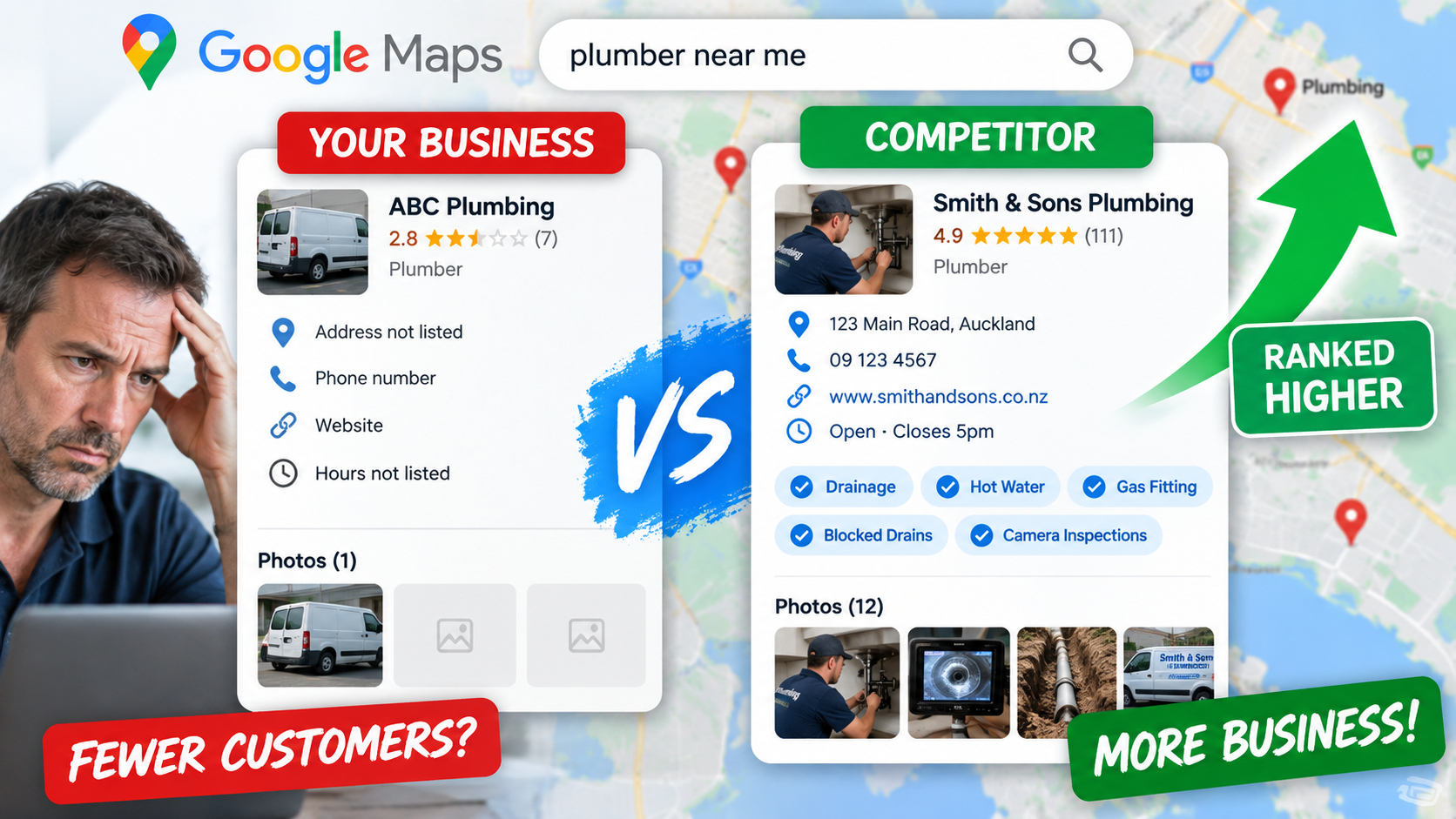
Reviews are a big part of this because customers naturally compare businesses.
Imagine someone finds three local companies:
- Business A has 7 reviews
- Business B has 18 reviews
- Business C has 55 reviews
Everything else being reasonably equal, the business with a substantial collection of good reviews may immediately look like the safer choice.
It's a little like playing Top Trumps. You want your business to have a strong enough card that when customers compare you with the alternatives, you remain in consideration rather than losing them at the final hurdle.
Reviews Can Do More Than Build Trust
Reviews aren't simply stars sitting beside your business name.
The wording customers use can also provide valuable context about what your business actually does.
For example, imagine you're a plumber who also supplies and installs water softeners. Not every plumber provides that particular service.
If recent customers naturally mention water softeners, the problem they had and the work you carried out, that creates much more useful context than a collection of reviews simply saying:
"Great job. Highly recommended."
You're getting genuine customer feedback while also giving potential customers a clearer understanding of the services you've successfully provided.
This is why I prefer feedback reviews — asking customers to explain the problem they had, the solution you provided and how well the job went.
If you'd like a simple process for generating more useful feedback from your existing happy customers, use my free Google Business Profile audit.
https://www.jamesroberts.co.nz/free-gbp-audit
Put the Three Factors Together
These three areas work together.
Relevance helps Google understand what you do.
Location helps Google understand where you should potentially be relevant.
Prominence helps establish whether your business is a strong and trusted option when compared with other local businesses.
Improving only one of these areas can leave opportunities on the table.
You might have fantastic reviews, for example, but the wrong primary category. Or you might have excellent categories but inconsistent location information.
Alternatively, Google may understand exactly what you do and where you operate, but prospective customers keep choosing competitors because their profiles look considerably more established.
The objective isn't to find one magic ranking trick. It's to build a stronger overall picture of your business.
Start With the Foundations
Google Business Profile optimisation can become complicated very quickly, but you don't have to fix everything at once.
Start by asking three questions:
- Have I selected the most relevant categories for what I actually do?
- Is Google receiving clear and consistent information about where my business operates?
- Does my profile give potential customers enough confidence to choose me over my competitors?
Those three questions will give you a useful starting point for identifying where your biggest opportunities may be.
Once you've got those foundations right, you can start looking at the other signals surrounding your Google Business Profile that can strengthen Google's understanding and customers' trust in your business.
Latest Episode
Insights to fuel your marketing business
Sign up to get industry insights, trends, and more in your inbox.
Contact Us
We will get back to you as soon as possible.
Please try again later.
James Picks
Video Title 1 Linked
Video Title 2 Linked
SHARE THIS
Latest Posts